

FAQ
Getting Started
1. What are the benefits of installing solar for my home?

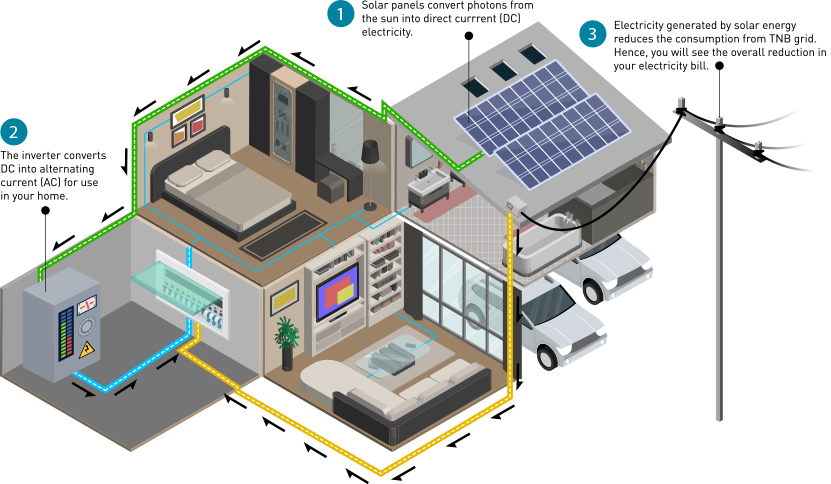
Image Source: tnb.com.my
Solar panels generate free electricity from sunlight, which your home uses during the day. This directly reduces your monthly TNB bill. Any extra energy your panels produce gets sent back to the TNB grid and further reduces what you owe. On top of that, solar protects you from future electricity price increases by TNB and adds value to your property.2. How much does it cost to install solar?
It depends on your home's electricity usage, roof size, and the system that is right for you. We carry three inverter brands at different price points, so there is usually a fit for most budgets. The best way to get an accurate number is through our free Power Study, which our team will give you a personalised consultation, assess your TNB bills, and give you a full quote with no obligation.
3. What financing options are available?
There are three ways to go solar with us. You can pay in full upfront, which gives you the lowest total cost and fastest payback. You can go on a monthly plan (IPP), where you spread the cost over time with fixed monthly payments that are often offset by your savings on your TNB bill. Or you can choose rent-to-own, where there is low upfront cost, and the system becomes yours at the end of the rental period. Our team will help you find the option that fits your situation.
4. What is a Power Study, and do I need one?
A Power Study is a free bill analysis from our team. We look at your roof, your electricity bills, and how your home is positioned to recommend the right system for you. We always do this before giving a quote because a system that is the wrong size for your home will either cost you more than it saves, or not save you enough.
How Solar ATAP Works
5. What is the Solar ATAP scheme?
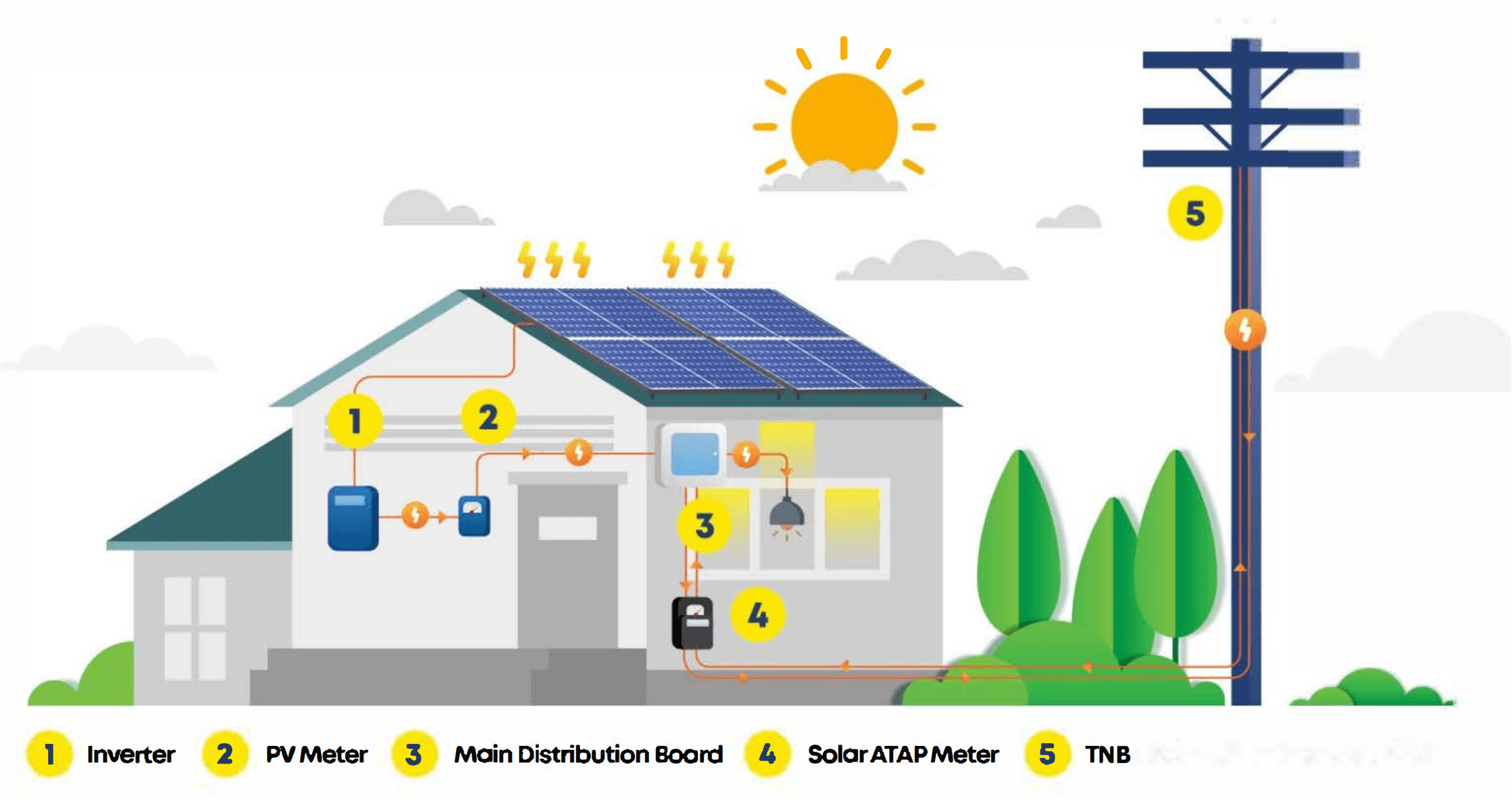
Image Source: tnb.com.my
Solar ATAP (Solar Accelerated Transition Action Programme) is the Malaysian government's current rooftop solar programme, which started on 1 January 2026. It replaced the old NEM 3.0 scheme. Under Solar ATAP, you install solar panels on your roof, use the electricity your panels generate, and send any leftover energy back to TNB in exchange for a credit on your bill. There is no fixed national quota, so more homeowners can now participate. The programme runs for 10 years and is managed by SEDA Malaysia.6. How much can I save on my electricity bill?
The biggest savings come from using your solar energy directly during the day for your air conditioning, appliances, and everyday usage. Every unit you use from your own panels is a unit you do not pay TNB for. Any extra energy you send to the grid earns a credit, though at a lower rate. The more you use during daylight hours, the more you save. Your free Power Study will give you a personalised savings figure based on your actual usage.
7. What happens if it rains or is cloudy?
Your panels still generate electricity on cloudy days, just less than on a sunny day. Solar panels work from daylight, not direct sunlight or heat. In Malaysia, we average around 3.5 sun hours per day throughout the year. On rainy days, your system still contributes, and TNB supplies whatever is still needed. It is more useful to look at your annual performance than to worry about individual rainy days.
8. What happens during a power outage?
Your solar system will automatically switch off during a TNB blackout. This is a required safety feature; it stops your panels from sending electricity into grid lines that TNB workers may be repairing. So if TNB goes down, your solar goes down too. The only way to keep your home powered during a blackout is to have a solar battery installed alongside your panels.
The SOLS Energy Difference
9. Why should I choose SOLS Energy?
A few things set us apart that no other solar company in Malaysia can match. As of October 2026, we have 9,517+ completed home installations and 37.9 MW of solar deployed across Peninsular Malaysia. PETRONAS (Malaysia's national oil company) chose to back us out of every solar company in the country. We offer the SOLS Life inverter, Malaysia's first home solar inverter brand, available exclusively through us. Every installation comes with 24/7 app monitoring so you can always see whether your system is running. And every installation we complete contributes to powering an Orang Asli (Indigenous) home through our 1=1 (Power To Empower) programme — no other solar company does this.
10. What is the 1=1 Power to Empower programme?
Every installation we complete contributes to powering a home for an Orang Asli family living completely off the grid, which means no electricity, no connection to any grid at all. Some of these families have never had light at night. We have already powered 4,700+ of these homes, and our target is 34,000 more across Peninsular Malaysia. When you go solar with us, you are part of that story.
Solar Battery
11. Can solar power my home during a power outage?
Only if you have a solar battery. Without one, your system shuts down the moment TNB has a blackout, even if the sun is shining. With a battery, your system stores the energy your panels produce during the day, and you can use that stored energy when the grid goes down or after sunset.
12. Why is a solar battery a smart addition under Solar ATAP?
Under Solar ATAP, using your solar energy yourself saves you more money than sending it to TNB. This is because the rate TNB credits you for exported energy is lower than what you pay to import energy from the grid. A battery stores the extra energy your panels generate and lets you use it at night — so instead of sending it to the grid at a lower rate, you keep it for yourself. It also keeps your home powered during blackouts.
EV Charging with Solar
13. Can I charge my electric vehicle using my solar panels?
Yes, and this is one of the best ways to get the most out of your solar system. ChargeSingh, our partner who offers home EV charging solutions, works with your solar panels so your car charges from the energy your roof generates during the day. You are essentially charging your car for free from the sun. Under Solar ATAP, using your solar energy directly rather than exporting it gives you the biggest savings, and charging an EV is a great way to do exactly that.
14. Can I install a ChargeSingh EV charger at a landed home or in a condominium?
You can install it in your landed home. Our team will install the charger with all wiring tidily hidden in conduit, the same day as your solar installation. ChargeSingh's EV chargers are IP67/IP68 rated, which means they are built to handle outdoor conditions, including rain. However, for condominium property, you will need to discuss it with your management first. Our team would be happy to help where possible.
Installation
15. After signing, how long before I start saving?
The physical installation itself takes about one day, typically around 7 hours from start to finish. However, for a system size >13kWp, the installation would take around 2 days (for installing the solar panels and also the wiring work). The full process from signing to your system being switched on — which includes your ATAP application, TNB meter work, and scheduling — usually takes 3 to 6 months. Once the system is live, savings start from your very next TNB bill.
16. What is the maximum solar system size I can install?
Under Solar ATAP, residential capacity limits are 5kWac for single-phase homes and 15kWac for three-phase homes. Our technical team will recommend the right size for your home based on your actual electricity consumption during the free Power Study. Under ATAP, the energy you use yourself is worth more than the energy you export, so getting the size right matters.
17. What warranty do I get?
Your solar panels carry a 25-year performance warranty; the system keeps producing long after it has paid for itself. Your inverter comes with a 10-year warranty, whether Huawei or SOLS Life. SOLS Energy also covers the installation with a 2-year workmanship warranty and a 3-month roof leak warranty (due to broken or misplaced tiles) from the date of installation.
18. What happens after 10 years?
Your Solar ATAP contract runs for 10 years. After that, your system moves into Self-Consumption mode. Your panels keep generating free electricity for your home, but any excess you send to the grid will no longer earn a bill credit. To make sure no solar energy goes to waste after year 10, we recommend planning for a battery — it stores what you do not use immediately so you can use it later.
Post-Installation
19. How do I keep track of my solar system?
We set up a monitoring account for you linked to your inverter. Through the app on your phone, you can see how much energy your system is producing each day and how your system is performing. Our team also monitors your system 24/7 on our end and will contact you if we spot anything that needs attention. You do not have to wait until something goes wrong.
20. My TNB bill does not show any solar exports. What should I do?
Start by checking your inverter. If the indicator light is green and the screen shows a power reading, your system is working fine. It is common for exports not to appear on your very first bill after installation. TNB needs one billing cycle to update its system. If it is still missing after your second bill, call TNB Careline at 1300 88 5454, make a report, get the report number, and email it to our Customer Support team (support@solsenergy.com). We will take it from there.


